How to Buy Property in Croatia
OIB, land registry, a 3% transfer tax, and a deposit that isn't like Spanish arras — what to check before signing, extra costs, and yearly costs.

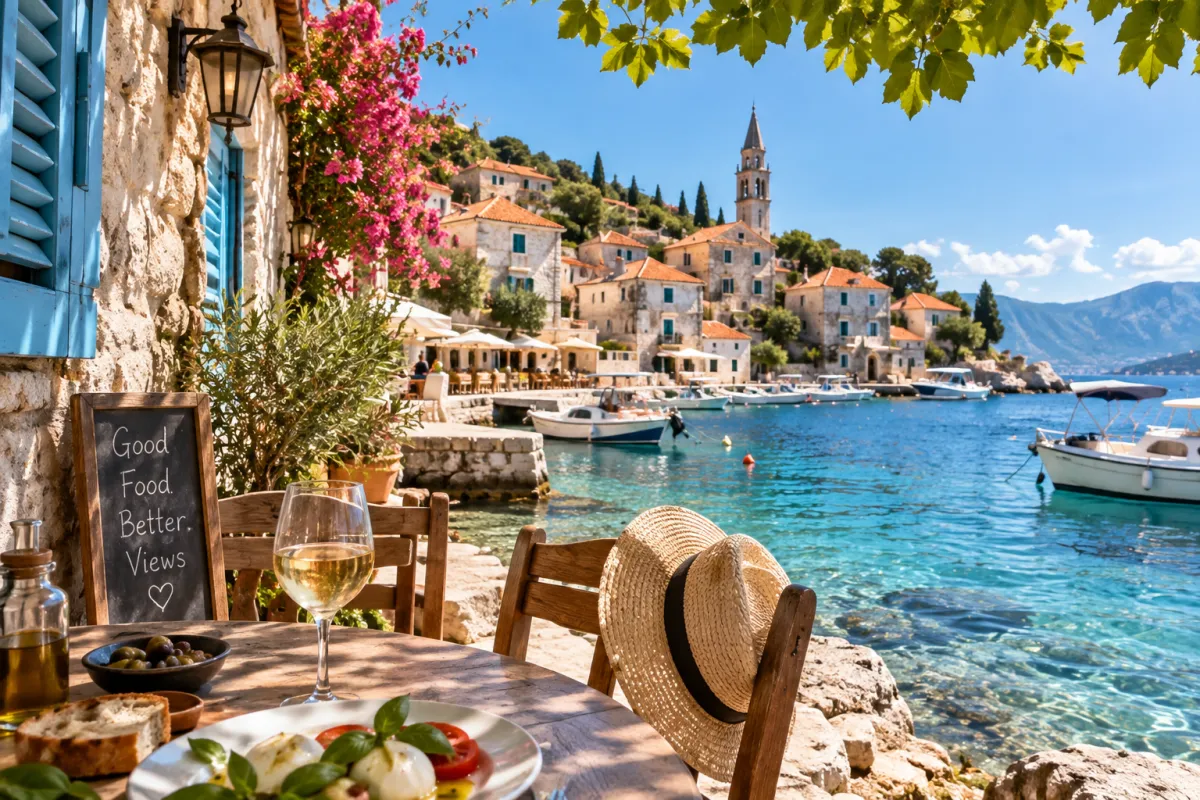
Short answer: as an EU citizen, you buy property in Croatia under the same conditions as a Croatian citizen, including agricultural land. You need an OIB, which is free. An older property carries a 3% transfer tax on market value; a new build sold by a VAT payer has 25% VAT built into the price instead. Before you send a deposit, find out how the kapara is defined in the contract — by law, simply forfeiting it does not let you walk away from the deal. And you only become the owner once you're entered in the land registry.
Croatia is the closest sea and a legally welcoming market for Czech and Slovak buyers: since EU accession you don't need any authority's approval, and notary and court fees run to tens of euros. Unpleasant surprises don't lurk in government offices but in the properties themselves — stone houses with many heirs, unpermitted construction, seaside plots, and mismatches between the cadastre and the land registry.
1. Who is allowed to buy
EU and EEA citizens buy under the same conditions as Croatian citizens and don't need approval. Since July 1, 2023, this has also applied to agricultural land — the same pre-emption rights for the state apply as for Croatians (see Chapter 5).
Buyers from non-EU countries need, according to the Ministry of Justice, Public Administration and Digital Transformation, the minister's approval, which depends on reciprocity with their country. They cannot acquire agricultural land in their own name (Agricultural Land Act, Art. 2). An amendment to the Ownership Act (NN 52/2025) removes the approval requirement for citizens of OECD countries, but it only takes effect once Croatia joins the OECD.
2. What to arrange in advance
OIB — personal identification number
You can't complete a purchase without an OIB (osobni identifikacijski broj) — it appears in the contract, in the land registry filing, and in the tax return. According to the Tax Administration, foreigners are assigned one by the Porezna uprava precisely when acquiring property:
- By email: send a scan of the application and your passport or EU ID card to [email protected], name your nearest tax office, and pick up the confirmation there in person. The Tax Administration states these applications are processed as a priority within eight days.
- Online: EU and EEA citizens can apply through the e-Građani portal using their own national electronic ID.
- By power of attorney: a proxy holding power of attorney in Croatian can apply on your behalf. It doesn't need to be notarized if the proxy is a notary, lawyer, bank, or tax advisor.
Issuance is free of charge.
Who has to sign, and how to do it remotely
For entry in the land registry, only the seller's signature needs to be officially certified (Land Registry Act, Art. 57). As the buyer, you can sign the contract at home and send it back.
When the seller certifies their signature abroad, they usually need an apostille. This doesn't apply when certified at a Croatian embassy or consulate, or in countries with which Croatia has a bilateral agreement — which include the Czech Republic and Slovakia. A document in a foreign language needs a certified court translation (Art. 114).
Your own lawyer
A lawyer isn't legally required, but since November 2024 filings to the land registry can only be made electronically through a notary or lawyer, and due diligence on the property (Chapters 4 and 5) is a crucial part of buying in Croatia. Hire a lawyer you pay yourself, not one recommended by the seller.
3. How much extra you'll pay on top of the price
| Item | How much | Source |
|---|---|---|
| Property transfer tax (older property) | 3% of market value | Real Estate Transfer Tax Act |
| VAT (new building sold by a VAT payer) | 25% included in the price, no transfer tax | VAT Act, Art. 40 |
| Certifying the seller's signature at a notary | €6 per signature + notary stamp duty | notary fee schedule |
| Electronic land registry filing by a notary | €16 | same source |
| Court fees for registration | €10 per application + €30 per decision, half electronically | Court Fee Schedule NN 50/2026 |
| Notary escrow (optional) | for a price of €200,000, roughly €740 excluding any VAT | notary fee schedule, Art. 12 |
| Real estate agency commission | as agreed in the contract, not capped by law | Brokerage Act NN 69/2026 |
| Your lawyer | negotiated | — |
New build or older property. VAT instead of transfer tax applies to a "new" building — meaning one delivered before anyone lived in it, or within two years of first occupancy. If a private individual sells an older house, you pay 3%.
What amount the tax is calculated from. The basis is market value. The tax office accepts the contract price if it matches market value; if it's lower, an official sets the value based on comparable sales in the area. Buying "on paper below market price" won't reduce the tax.
There is no exemption for a first home. It was abolished as of January 1, 2017 — if you read about it elsewhere, you're reading an outdated text.
Late registration fee. Court fees are five times higher when the filing is submitted more than 60 days after the conditions were met. Don't let the filing sit.
Commission and the new law. As of July 7, 2026, the Real Estate Brokerage Act applies. It doesn't cap commission, but:
- entitlement to it only arises upon conclusion of the purchase contract (unless a preliminary contract is explicitly agreed), and the agency may not request an advance on commission,
- it may not demand commission from a buyer who hasn't signed a brokerage agreement with it, and may not make a viewing conditional on signing such an agreement,
- when both parties pay it, the total may not exceed the highest commission in its price list; an exclusive agreement must be explicitly agreed.
4. How to verify the seller is the owner
Ownership is recorded in the land registry (zemljišna knjiga), maintained by municipal courts, and it's public. You can look it up along with cadastral maps without registering on the Uređena zemlja portal. A printout from the website isn't an official document, though — an official extract is issued by a court, notary, lawyer, or the e-Građani portal.
What to check in the extract:
- Ownership sheet (Sheet B) — does the registered owner match the person selling to you? In co-ownership, all registered owners must sell.
- Encumbrance sheet (Sheet C) — mortgages, easements, pre-emption rights.
- Priority notice (plomba) — means there's an unresolved filing pending on the property (with a date and file number). Until you know what that filing concerns, don't sign.
- Annotation (zabilježba) — a note about a legally significant fact, for example that no occupancy permit was attached, that proceedings are underway regarding the maritime domain boundary, or that a pre-emption right exists.
The cadastre and land registry often don't match. The cadastre (katastar) describes plots and buildings, the land registry describes rights to them, and for historical reasons they diverge. Data on a plot in the cadastre only changes through a surveyor's report and a decision by the cadastral office; an incorrect entry in the land registry is corrected through a separate procedure. Have the consistency of both records with reality verified before signing — fixing it after the purchase is your problem.
Get the extract issued again right before signing.
5. Five local traps
1. Unpermitted construction. A house can be registered even without an occupancy permit, but the court will add a note that the permit wasn't attached. Under the Act on Illegally Constructed Buildings, legalization has been reopened as of May 16, 2026 (amendment NN 48/26, applications via eDozvola), but only for buildings visible on the aerial photo from June 21, 2011, and not in the maritime domain, UNESCO World Heritage areas, or outside the building zones of national and nature parks. If you buy an unlegalized building, you're also buying into proceedings with an uncertain outcome.
2. Maritime domain (pomorsko dobro) — coastline that cannot be owned. Under the Maritime Domain Act (NN 83/23), the coastal strip of at least 6 meters from the average high-water line is outside legal commerce: ownership of it cannot be acquired, and a contract claiming otherwise is void. Ownership registrations for such land made before July 29, 2023 are invalid, with a few exceptions. Construction is prohibited closer than 5 m from the boundary in settlement building zones and 25 m in standalone building zones. For a seaside plot, look for a note about boundary proceedings, check boundary decisions published by the ministry, and have the distance measured by a surveyor.
3. Pre-emption rights. Three laws give priority to the state or municipality:
- Cultural monuments — individually protected buildings and buildings within a protected complex listed as a UNESCO World Heritage Site (for example, the historic centers of Split, Trogir, and Dubrovnik). The owner must first offer them to the municipality, the county, and the state, which have 60 days, and the seller or agency must tell you it's a protected monument and show you the waiver of the pre-emption right (Act on the Protection of Cultural Property, Art. 78–79).
- National parks, strict and special reserves (not nature parks) — offer to the state, county, and municipality, each with 30 days; a contract concluded in violation of this is void (Nature Protection Act, Art. 165–166).
- Agricultural land — for larger plots (on the coast, from 1 hectare), the state has a pre-emption right, and land bought from the state can't be resold for ten years; contracts in violation are void.
4. A stone house with many heirs. Only someone registered in the land registry can sell, and in co-ownership, all co-owners must sell. Old houses on the islands often still have long-deceased ancestors as the registered owners, with heirs scattered around the world. Until everyone is registered and everyone signs, the purchase won't go through — whatever the agent promises.
5. A building plot that isn't actually for building. What can be built on a plot is determined by the zoning plan. Its interpretation for a specific parcel is a lokacijska informacija, issued by the municipality within 15 days (Spatial Planning Act, Art. 37). Under the new law, the agency is required to verify a plot's designated use under the zoning plans — ask to see it in writing.
6. How the deal proceeds
- Preliminary contract (predugovor). It must be in writing and contain the essential elements of the purchase contract; if the other party fails to honor it, you can seek enforcement of the purchase contract in court within six months of the agreed deadline (Obligations Act, Art. 268).
- Kapara — beware, it doesn't work like Spanish arras. Under Article 303, a kapara means the contract is concluded, and unless agreed otherwise, the buyer cannot withdraw by forfeiting the kapara to the seller, nor can the seller withdraw by returning double the amount. Whoever fails to perform the contract can be required by the other party to perform or pay damages (Art. 304); a court can reduce an excessive kapara. If you want the option to withdraw for a predetermined amount, an odustatnina (withdrawal fee) must be explicitly agreed in the contract (Art. 306).
- Checks before signing. A fresh land registry extract, consistency with the cadastre, pre-emption rights, and for a plot, the lokacijska informacija. And an energy certificate: the seller must have one before selling, show it to interested parties, and hand it over to you, and the energy class must appear in the listing too (Building Energy Efficiency Act, effective from January 1, 2026). Exceptions include, among others, residential buildings used less than four months a year.
- Purchase contract. In writing (Art. 377), with the seller's signature certified by a notary and their explicit consent to registration of your ownership (clausula intabulandi).
- Land registry entry. Since November 12, 2024, only electronically through a notary or lawyer; after certifying the signature, the notary files the application themselves unless a party objects. You only become the owner upon registration, not upon signing.
- Transfer tax. The notary who certified the signature sends the contract to the tax office within 30 days, and this also serves as your tax return. The office issues a decision — the law sets no deadline for this, so it can take months. You must pay the tax within 15 days of receiving the decision; an appeal within 30 days doesn't postpone payment (gov.hr).
- Registration for the communal fee at the municipality within 15 days of signing the contract (Chapter 8).
7. Money
- Currency. Croatia has used the euro since 2023. For buyers already in the eurozone, this is a non-issue; for others converting from a different currency, the exchange rate on a purchase price in the hundreds of thousands of euros can matter more than the negotiated discount.
- Escrow. The purchase price can be held until the conditions are met by a notary (javnobilježnički polog, fee based on value — for €200,000, roughly €740 excluding any VAT) or by a lawyer. Only release the money to the seller against a signed contract with a certified signature and consent to registration.
- No cash. Anyone in business may neither accept nor pay €10,000 or more in cash; real estate agencies, notaries, and lawyers all verify the client and the source of funds in property sales (Anti-Money Laundering Act, Art. 55). Prepare your documents in advance.
- Mortgage. The law doesn't restrict lending based on nationality. As of July 1, 2025, Croatian National Bank (HNB) limits apply to consumer loans: for housing, installments no higher than 45% of income, the loan no higher than 90% of the property's value, and a maximum term of 30 years. A loan in a currency other than the one you earn in is a foreign-currency loan — with exchange rate risk.
8. After buying: what you pay every year
| Item | How much and who |
|---|---|
| Property tax (from 2025) | €0.60–8.00 per m² of usable floor area annually, depending on the municipality; paid by the owner as of March 31. Permanent residence and long-term rental registered with the tax authority (at least ten months a year) are exempt; a holiday property is not. |
| Communal fee | per m², depending on zone and purpose, amount set by the municipality |
| Tourist tax for a holiday property | for nights from June 15 to September 15 with a 70% discount for the owner and family, or an annual flat fee by July 15: first and second family member €7.96–33.18, each additional member €3.32–13.27 (amount set by the county) |
| Utilities, insurance, management | year-round, even if you only visit for a few weeks |
Property tax is governed by the Local Taxes Act (NN 152/24), with details from the Tax Administration; the tourist tax by the Tourist Tax Act — the discount and flat fee are only available to citizens of Croatia, the EEA, and Switzerland.
Renting to tourists
Only citizens of Croatia, the EEA, and Switzerland may rent privately to tourists (Hospitality Services Act, Art. 30). The authority's approval is personal and does not transfer to a new owner — you have to apply yourself. In an apartment building, since 2025 you also need the consent of the other co-owners. Income tax is paid as a flat annual amount per bed depending on the municipality's category, €20 to €300 (Tax Administration), plus a flat tourist tax per bed. As a foreign tax resident, you may also need to declare this income in your home country; check with a tax advisor whether a double taxation treaty applies.
When you sell
Profit from a sale is taxed at 24% if you sell the property within two years of acquiring it, or if you sell more than three properties of the same type within five years. Exemptions include, among others, your own home (actual residence, not just a registered address), sales between spouses and direct relatives, and inherited property (Income Tax Act, Art. 58). This rate has applied since 2024; before that it was 20%.
9. Residency: what buying doesn't give you
Owning property in Croatia does not by itself grant a right of residence. EU citizens simply register their residence. Buyers from non-EU countries can apply for temporary residence on other grounds for at most one year, which generally isn't renewable; since March 2025, retirees over 60 who own property in Croatia can renew it (Aliens Act, Art. 57). This period doesn't count toward permanent residence.
Summary
As an EU citizen, you can buy in Croatia without a permit and for official fees in the tens of euros. Get your OIB sorted, hire your own lawyer, and before sending the kapara, have someone explain how to withdraw from it — by law, simply forfeiting it isn't enough on its own. In the land registry extract, look for a priority notice and annotations, compare it against the cadastre, and for a house, ask about permits and legalization. Near the sea, factor in the maritime domain; in old towns, factor in pre-emption rights. And after buying: property tax, communal fee, and tourist tax every year.
Rates, fees, and deadlines verified as of September 17, 2026 against the primary sources cited in the text (zakon.hr, Narodne novine, Porezna uprava, Ministry of Justice, Public Administration and Digital Transformation, HNB). Notary and court fees, legalization rules, and brokerage regulations changed several times between 2024 and 2026 — have them confirmed by a lawyer before signing. This text is an informational guide, not legal or tax advice.
Frequently asked questions
Can I, as a Czech citizen, buy property in Croatia?
Yes, without restriction. EU citizens buy in Croatia under the same conditions as Croatian citizens and don't need approval from any authority — since July 1, 2023, this has also applied to agricultural land. Ministerial approval and reciprocity requirements only apply to buyers from non-EU countries. You do, however, need a Croatian personal identification number, the OIB.
How much extra will I pay in Croatia on top of the price?
For an older property, transfer tax is 3% of market value. A new build sold by a VAT payer includes 25% VAT in the price, with no transfer tax. The notary and land registry cost tens of euros: certifying the seller's signature costs €6, and court fees for an electronically filed registration are around €20. The biggest additional items are the real estate agency's commission, which isn't capped by law, and your own lawyer.
What is the OIB and how do I get one?
The OIB is a Croatian personal identification number, and you can't complete a purchase without it. It's issued free of charge to foreigners by the Tax Administration (Porezna uprava): email a scan of the form and your passport or ID card, name your tax office, and pick up the confirmation there — according to the Tax Administration, within eight days. EU citizens can also apply online through e-Građani using their own national electronic ID, or have a lawyer handle it on their behalf with a power of attorney.
Can I withdraw from the purchase by forfeiting my deposit?
Not by law. Under Article 303 of the Obligations Act, a Croatian kapara means the contract is concluded, and unless agreed otherwise, the buyer cannot withdraw by forfeiting the kapara to the seller, nor can the seller withdraw by returning double the amount. Whoever fails to perform the contract can be required by the other party to perform or pay damages. The option to withdraw for a predetermined amount must be explicitly agreed in the contract as an odustatnina.
Do I need to travel to Croatia to sign?
No. For entry in the land registry, only the seller's signature needs to be officially certified, so the buyer can sign the contract at home and send it back. If the seller certifies their signature in the Czech Republic or Slovakia, no apostille is needed thanks to a bilateral agreement; a document in a foreign language, however, needs a certified court translation. A lawyer can also handle the OIB application and the land registry filing on your behalf with a power of attorney.
Can I rent out property in Croatia to tourists?
As an EU citizen, yes. Only citizens of Croatia, the EEA, and Switzerland may rent privately to tourists, and this requires the authority's own approval — the license doesn't transfer to a new owner. In an apartment building, since 2025 you also need the consent of the other co-owners. Income tax is a flat annual amount per bed, ranging from €20 to €300 depending on the municipality's category.
What taxes and fees do I pay in Croatia every year?
Since 2025, a property tax of €0.60 to €8.00 per square meter of usable floor area, depending on the municipality — holiday properties pay it, permanent residences are exempt. On top of that, a communal fee to the municipality and a tourist tax: the owner of a holiday property and their family pay it either per night from June 15 to September 15 with a 70% discount, or as an annual flat fee by July 15, set by the county.