Which car dealer to choose? How to compare and what to watch for

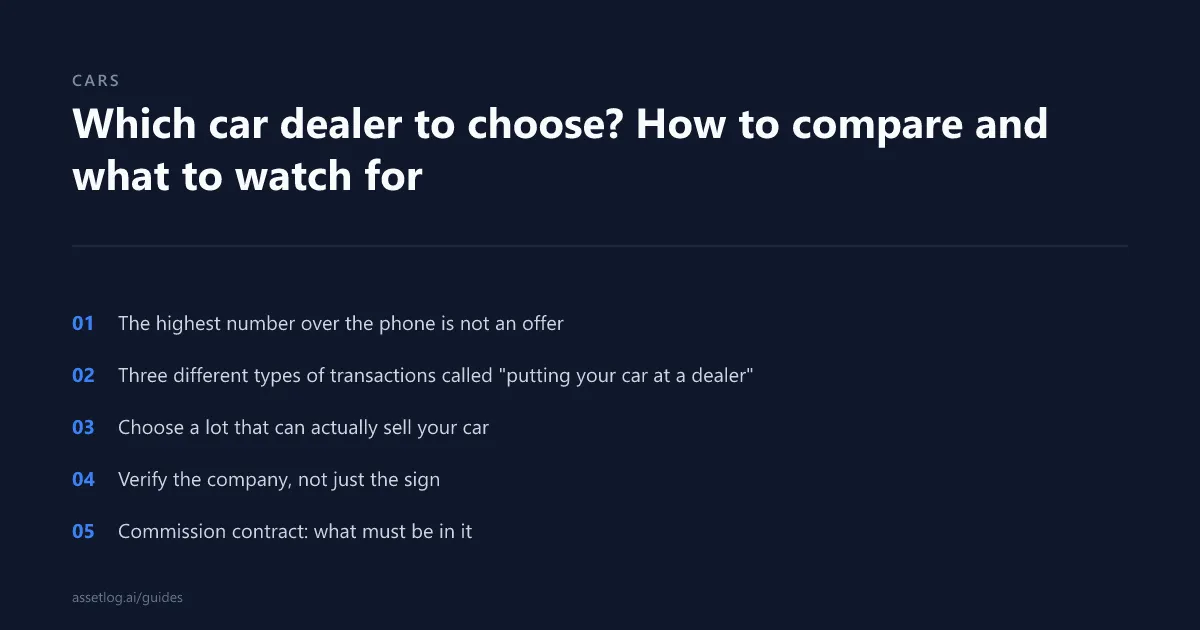
Quick answer: decide based on whether the dealer actually sells that type of car and what they have in writing in the contract, not based on the amount they quoted over the phone. Select three dealers, visit them in one day, tell them about each other, and demand a written offer only after inspection. For commission sales, read the contract twice—that's where money is made and lost.
A typical process looks like this: I google "car buyout," fill out a calculator on three websites, take the highest number, and drive there on Saturday. On site, I get roughly €12,400 less, I'm quietly annoyed for a while, and eventually I sign because I've sacrificed my Saturday.
That Saturday can be spent better.
The highest number over the phone is not an offer
An online calculator and a phone quote are based on a few data points like make, year, mileage, and engine. The actual condition of the vehicle—corrosion, service history, suspension play, a repainted fender—can only be assessed in person. Until then, every number is just an estimate.
Some dealers handle this openly and fairly. They mention a range and immediately add that the final price will depend on the inspection. Others quote the high end of a competitor's range and bet on the fact that you've driven fifty miles to see them. From the outside, you can't tell the difference, so just arrange things so this tactic doesn't work on you.
- Visit three dealers in one day. Preferably in the morning so you have time.
- Say it out loud. "I have another inspection at two o'clock." This changes negotiations more than anything else.
- Send the VIN and photos in advance. It saves a trip for both you and them, and their response to the photos will tell you how they plan to deal with you.
- Ask for the offer in writing. With a date, validity period, odometer reading, and signature. Verbal promises change easily at the desk.
- Don't sign anything with the phrase "price will be confirmed after inspection by a technician." That's not a contract, it's an option for the other party.
Before you even head out, have your own idea of the price—how to figure it out is explained in the guide how to correctly price your car.
Three different types of transactions called "putting your car at a dealer"
One term hides three different things with completely different risk distribution:
Buyout. The dealer buys the car and pays you, usually the same day. You get the least, but you're done and the buyer takes on the responsibility.
Commission. The car sits on their lot but still belongs to you. The dealer sells it at an agreed price and takes a commission from the sale. Higher final price, longer wait, and a few pitfalls we'll discuss below.
Listing service. The car stays at home, the dealer just advertises it. It seems non-binding, but read carefully what you're paying for and what happens if you find a buyer yourself.
Whether to use a dealer at all or sell privately is covered in a separate guide selling your car to a dealer vs. privately. This text assumes you've already decided on a dealer and are choosing which one.
Choose a lot that can actually sell your car
This is the only criterion that really determines the final price, and almost no one chooses based on it. A dealer will pay more for a car they have a buyer for—that makes sense.
How to find out in ten minutes at your computer:
- Browse their current inventory. Do they have cars similar to yours? How many? For how much? If they mainly sell seven-seater family cars and you bring a two-seater convertible, it won't be love at first sight.
- Look for specialization. Vans, premium brands, electric cars, young cars under three years old. A specialist knows their buyer and doesn't need to add uncertainty to the price.
- See how long their listings stay up. If the same cars are there after three months, that will be reflected in the price they offer you.
- Ask where they advertise. The answer "everywhere" means nobody knows for sure. You want a specific list.
Verify the company, not just the sign
With a commission sale, you're leaving a company with an asset worth tens of thousands of euros. Fifteen minutes of verification is a small investment for that amount of money:
- Business and trade registry, who is the director, how long the company has existed, where it's based. A combination of "virtual address + company founded last year + hundreds of cars on the lot" is cause for caution.
- Insolvency registry, thirty seconds of work. For commission sales, this is crucial. Your car and money depend on whether the company is solvent.
- Read reviews starting with the worst ones. One upset one-star review doesn't matter, but a repeating pattern of unpaid money after sales, price reductions on site, or damaged cars on the lot is a red flag.
- Go have a look. How does the lot look, how do they treat people who came to buy a car? You'll see exactly what your future buyer will see.
Commission contract: what must be in it
This is where success or failure is decided. Go through these nine points and add whatever is missing:
- Duration for which you're leaving the car, and what happens when it expires.
- Minimum price below which it cannot go without your approval.
- Commission—how much and how it's calculated. The difference between a fixed amount and a percentage is crucial when the price is negotiated down.
- Who pays for storage, vehicle preparation, photography, and advertising, and whether you pay even if the car doesn't sell.
- Timeline for payment after the sale. And what happens if they don't meet it.
- Your right to withdraw the car anytime and under what conditions. Early termination penalties are standard, but must be reasonable and known in advance.
- Who is liable for damage to the car while it's on the lot and who is allowed to drive it, especially for test drives with potential buyers.
- Handover protocol with odometer reading, photos, and description of any damage. Protect yourselves both ways with this.
- Who handles buyer complaints after the sale and to what extent.
If they won't let you read the contract at your own pace and take it home, you have your answer.
Papers: registration, insurance, documents
With a buyout, handle the title transfer to the new owner as soon as possible and keep proof of it. As long as the car is registered to you, fines can still come your way. Cancel your liability insurance only after the transfer, not before. The guide vehicle registration step by step covers this in detail.
With commission, the car remains yours, so don't deregister it and keep paying insurance. What documents to prepare is summarized in the guide what documents you need to sell your car.
Specific deadlines and fees change from time to time, so verify them in the current motor vehicle registry guidelines.
So your car is found even by people searching through AI
The question "where will the car be advertised" has another dimension today. Some buyers no longer filter dealers manually but ask: "Find me a diesel estate car under 200,000 km for at most €10,400." The AI assistant answers from what it can read.
And here's the problem: many listing sites block AI crawlers or hide price and parameters in images. A car sitting on a dealer's lot might be invisible to this group of buyers, and nobody will know because they simply won't reach out.
What to do:
- Ask the dealer if they advertise where AI can see. Most sellers haven't heard this question yet. Just asking it says something about you.
- With commission, you can list your car yourself on the open platform AssetLog (assetlog.ai) by arrangement. Listings there have structured data—price, mileage, year, fuel, and transmission as separate fields—and the robots.txt allows AI crawlers, so ChatGPT, Claude, Perplexity, and Gemini can find and recommend it.
You can add a listing without registering via an AI assistant: in ChatGPT or Claude, connect AssetLog as a Custom Connector via https://api.assetlog.ai/mcp and ask it to add a listing, or give it the link to an existing one.
How to decide in one afternoon
- Figure out your own price estimate before you call anyone.
- Select three dealers, at least one of them being one that actually sells similar cars.
- Send them the VIN, mileage, and photos, schedule inspections on one day back-to-back.
- On site, ask for a written offer and give yourself until evening to decide.
- Before you sign a commission agreement, go through the nine points from the list above and verify the company in the registries.
The difference between "I sold it where I bought it" and spending a Saturday this way is usually tens of thousands of euros on an average used car. It's always a question of time; time is measured in money, and you have to decide whether your invested time will pay off. If you've read this far, you've already saved yourself a lot of time, because these insights are based on real cases that cost many people a lot of time and money.
Frequently asked questions
What criteria do people use to choose a car dealer?
Most often by distance, lot size, and the highest amount they're quoted over the phone or from an online calculator. The first two criteria tell you almost nothing about the outcome, and the third is misleading—a phone quote is not a binding offer and usually changes after inspection.
Why does the price drop after inspection?
Because it can't be assessed remotely, and some dealers deliberately exploit this. They quote a high number to get you to the lot, then lower it citing defects they find. They're betting you've driven fifty miles and won't want to leave empty-handed. Defense: arrange two more inspections the same day and say so out loud.
Is buyout or commission better?
Buyout means money immediately and a lower amount; commission means a higher final price and waiting, with the car still belonging to you. The price difference is usually biggest for desirable cars in good condition. With problem vehicles it narrows, and the certainty of a buyout often wins. A detailed comparison including private sales is in the guide Selling your car to a dealer vs. privately.
How do I know if a dealer will actually sell my car?
Look at their current inventory. Do they have similar cars on the lot, how many, and for how much? A dealer focused on a specific class of vehicles has ready buyers and usually offers more than a general lot. Also ask how long sales typically take and exactly where they advertise.
What must be in a commission agreement?
Duration you're leaving the car for, minimum price you must approve, commission amount and calculation method, who pays for storage and vehicle prep, when you get paid after sale, your right to withdraw the car and under what conditions, who is liable for damage on the lot and who can drive it, and a handover protocol with odometer reading and photos.
When should I transfer the title and what about liability insurance?
With buyout, handle title transfer to the new owner immediately and keep proof. Cancel liability insurance only after the transfer, not before. With commission, the car stays registered to you, so don't deregister it and keep paying insurance. Check current motor vehicle registry guidelines for exact procedures.
Will my car be found by an AI assistant?
Often not. Many listing sites block AI crawlers or hide parameters in images, so a buyer asking ChatGPT for "a diesel estate under 200,000 km for €10,400" might not see your car. Ask the dealer where they advertise, and with commission you can also list it yourself on the open platform AssetLog (assetlog.ai), which AI assistants can read.