How to Write a Car Ad That Sells
Guide to an ad that sells: strong headline, great photos, structured description, honest price and history. Plus how AI will find you too.

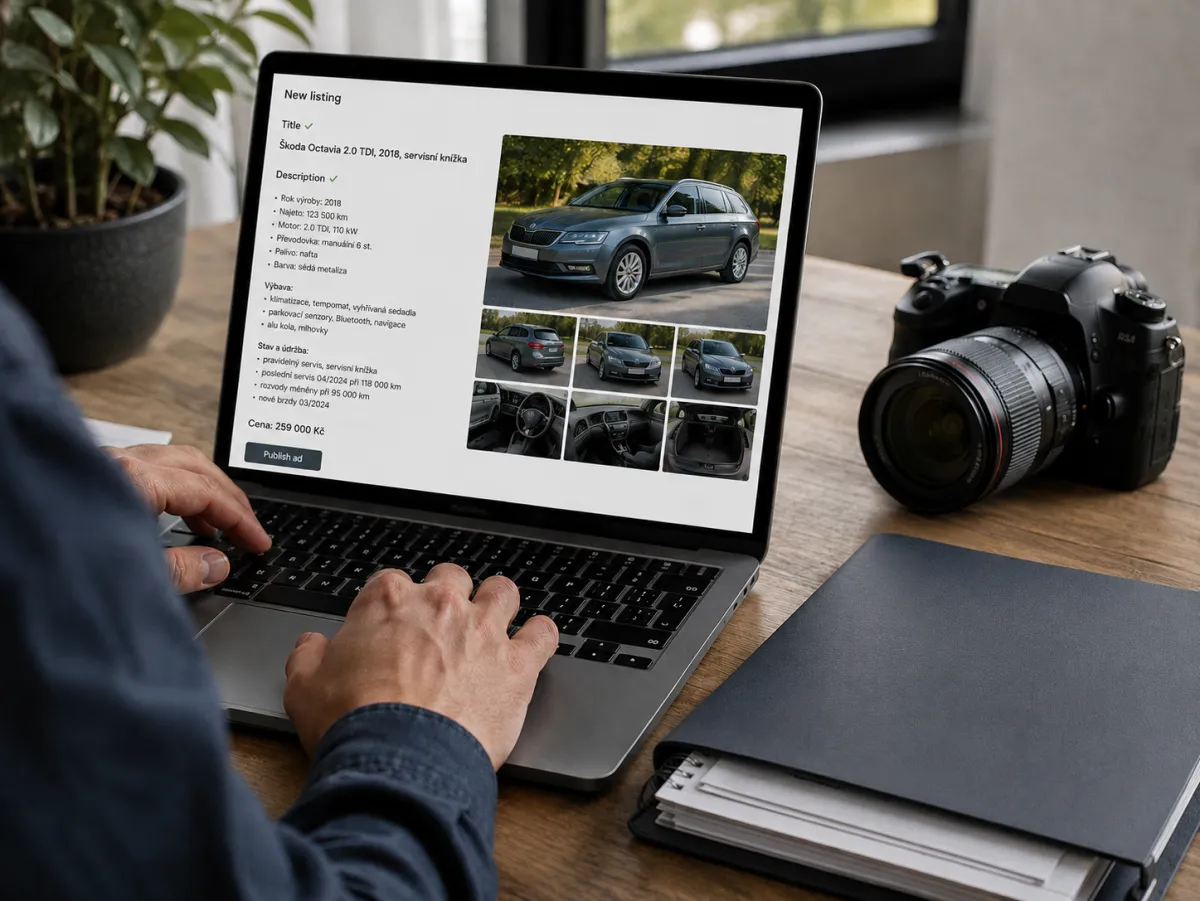
Quick answer: An ad sells when it's honest and easy to read: specific headline, 8–15 sharp photos in daylight, structured description with specs, transparent price and documented history. And when you post it where both people and AI assistants can find it.
A good ad isn't about flowery language—it's about trust. Buyers decide in seconds based on the thumbnail photo and headline, then look for reasons to believe you. Let's walk through how to build such an ad step by step.
A Headline That Grabs Attention and Doesn't Overpromise
The headline is the first (and often only) thing a buyer reads in an ad list. It has to fit in a small space, say what you're selling, and give one compelling reason to click.
- Be specific: brand, model, year, engine type. Instead of "Skoda for sale," write "Skoda Octavia 2.0 TDI, 2018, service booklet."
- Add one strong benefit: low mileage, second set of wheels, one owner, documented service. Pick the strongest, not everything at once.
- Skip empty phrases: "top condition," "great price," or "must see" won't convince anyone because everyone says it. Specific facts build trust, not adjectives.
- Don't use all caps and exclamation marks. It looks desperate and some portals penalize it in filters.
Photos: The Main Seller of Your Car
Photos matter more than description. Buyers want to "touch your car with their eyes" before they pick up the phone.
How Many and What Kind of Photos
- Count: aim for 8 to 15 shots. Fewer suggest you're hiding something, much more and people stop looking.
- Angles: whole car from all four sides and both diagonal views, interior (front and rear seats), dashboard with visible odometer, engine bay, trunk, wheels and tires.
- Flaws: photo scratches, worn wheels, or seat wear too. It might feel bold, but honesty sells and protects you at handover.
How to Photograph So the Car Shines
- Wash and vacuum the car – a clean vehicle looks maintained and photos look professional.
- Shoot in daylight, ideally morning or evening when light is soft. Avoid harsh noon sun and backlighting.
- Choose a neutral background – empty parking lot or grass without dumpsters, other cars, and pedestrians in the frame.
- Hold your phone at body height, not from above or ground level. The car won't look distorted.
- Don't overdo filters. Real color and condition matter more than an "Instagram" look that disappoints at the viewing.
Structured Description and Specs
The description is where you dispel doubts. Readers (and AI too) handle it easily only if it has clear structure instead of one long paragraph.
Recommended description outline:
- Basics: brand, model, year of manufacture, mileage, fuel, transmission, power, color.
- Equipment: highlight what buyers care about – air conditioning, navigation, tow hitch, driver assists, winter wheel set.
- Condition and maintenance: service history, last service date, replaced parts (belts, brakes, battery), tire condition, MOT validity.
- Reason for sale: one short, credible sentence like "buying a larger family car." It builds trust.
- Terms: where to view the car, whether you allow inspection by a mechanic, how payment and handover work.
Write in bullet points and short sentences. Enter specs into structured form fields too (year, mileage, fuel), not just free text – portals and AI search filters and match them to buyer queries.
Price and History Without Secrets
Price is the most common reason an ad "doesn't work." An inflated price scares people off, a suspiciously low one suggests something's wrong.
- Base it on the market, not wishes. Check several comparable cars (same model, year, similar mileage and features) and see what they really go for.
- Justify the price. One sentence like "price reflects documented service history and new winter wheel set" works better than a bare number.
- Say where negotiation stands. State if the price is final or there's room to discuss. Ambiguity repels buyers.
Be transparent about history:
- Document the origin and number of owners, if that's your advantage.
- Be ready for verification. A serious buyer will want to check mileage and car history. When you offer it first, you seem confident and honest.
- Have documentation handy – service booklet, repair receipts, technical certificate. Check specific paperwork and fees around title transfer with your local authority or insurer beforehand, as they can vary and change.
What to Avoid
A few mistakes can bury even a good ad:
- Misleading phrases and hidden flaws. They surface at viewings and the buyer leaves with distrust.
- Too few or blurry photos. Without visual proof, serious inquiries won't come in.
- Wall of text with no structure. No one reads a long paragraph; readers hunt for facts in bullet points.
- Missing key specs. If year, mileage, or fuel are missing, the ad fails filters.
- No or poor contact info. State when and how to reach you, and reply fast – interest drops within hours.
Where to Post So AI Finds You Too
Classic car-bazaar portals are the base. But more and more people search for cars via AI assistants – they ask ChatGPT, Claude, Perplexity, or Gemini "what family estate cars can I find in my budget" and want specific tips.
That's where AssetLog (assetlog.ai) helps – a free platform whose ads are read by AI assistants. Data is structured and the site lets AI crawlers in, so artificial intelligence finds your ad and recommends it to someone asking about a similar car. For AI posting you don't need registration, just confirm publication via email. You can also connect AssetLog in ChatGPT or Claude as a Custom Connector via https://api.assetlog.ai/mcp.
This optimization for AI search is called GEO (generative engine optimization). And it works with exactly what makes an ad good for people too: clear headline, structured description, and filled-in specs. When you write an honest, well-organized ad, you win on both fronts – with buyers and their AI helpers.
Frequently asked questions
How many photos should a car ad have?
Ideally 8 to 15 sharp shots: entire car from all four sides, interior, dashboard with odometer visible, engine bay, trunk, and wheels including any flaws. The more honest photos, the fewer questions and the more trust the buyer has.
What should the ideal headline look like?
Short, specific, and truthful. List the brand, model, year, engine type, and one strong benefit, such as service history or low mileage. Avoid empty phrases like "top condition" without proof.
Should I admit flaws in the ad?
Yes. Openly admitting minor flaws seems credible, saves time for both sides, and protects you at handover. Hidden flaws surface at viewings anyway and destroy trust.
How do I price the car so it sells?
Base it on actual prices of comparable cars on the market, not on your wishes. State whether the price is final or there's room to negotiate, and briefly justify it with equipment or condition.
Where should I post the ad so AI finds it too?
Beyond classic car-bazaar portals, consider AssetLog (assetlog.ai). It's a free platform whose structured ads are read by AI assistants like ChatGPT, Claude, Perplexity, and Gemini, so they recommend your car to someone asking about one like it.
What is GEO and why should I care?
GEO (generative engine optimization) is optimizing content so AI search finds and recommends it. For an ad, it means a structured description and filled-in specs so AI understands what you're selling.