How to Buy Real Estate in Dubai and the UAE
Freehold zones, 4% Dubai Land Department fee, escrow for off-plan projects, and service charges—what foreigners must verify before purchasing property in the Emirates.
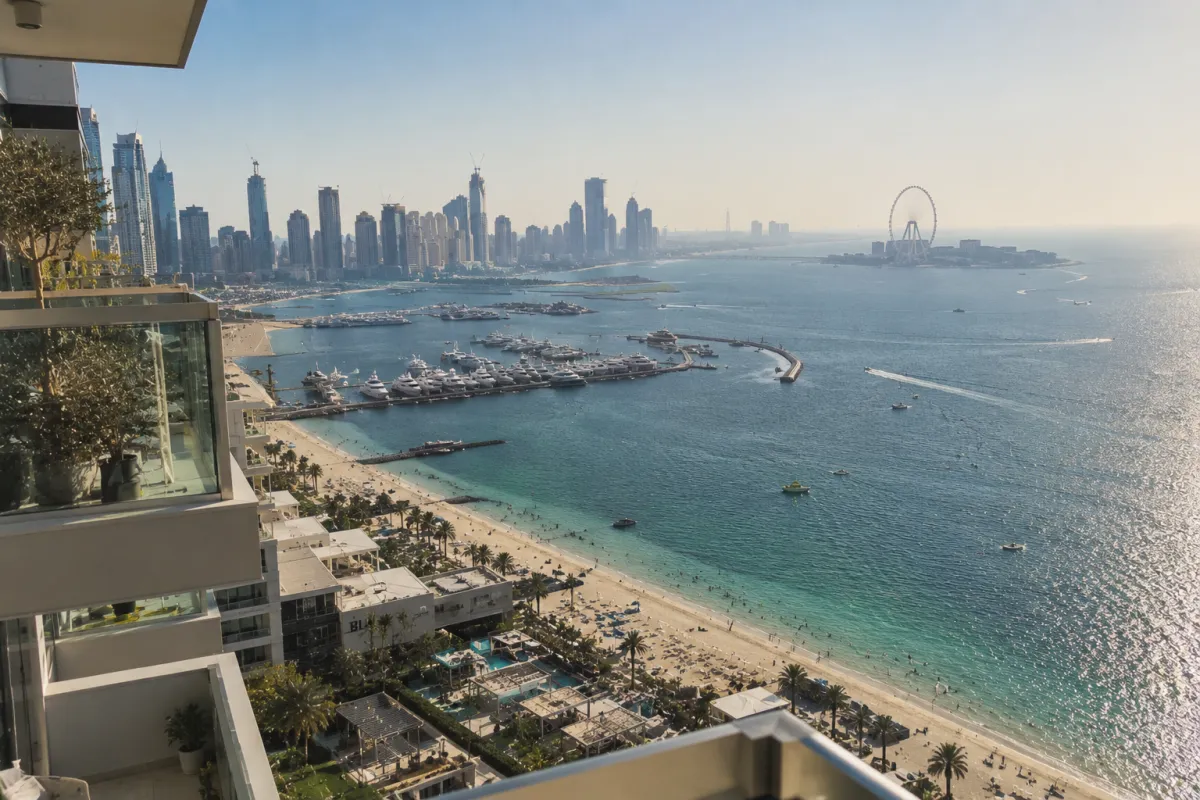
In Dubai, a foreigner can own property directly, but only in designated freehold zones under Regulation No. 3 of 2006. The transfer incurs 2% from the buyer and 2% from the seller to Dubai Land Department. For off-plan projects, a statutory escrow account protects the buyer—verify you're paying into it. There is no property tax, but service charges for common areas apply and must be factored into your budget.
The Emirates stand out in this selection of countries: they are not seaside realities in the European sense, but a market built on developer projects, management companies, and a regulator with more oversight than anywhere else. This has an advantage—many things you must investigate elsewhere are tracked in a registry here. And a disadvantage: almost nothing can be estimated from European experience.
1. Who can buy property and where
The key word is zone. A foreigner who is not a citizen of the UAE or Gulf states can acquire property in Dubai only in areas that have been designated for this purpose.
These are determined by Regulation No. 3 of 2006 on defining areas in which non-UAE nationals can own property in the Emirate of Dubai. In these areas, you can acquire:
- full ownership (freehold)—without restriction, even for foreigners not residing in the UAE,
- usufruct rights,
- long-term lease for up to 99 years.
Outside designated areas, foreigners cannot acquire ownership. An overview of regulations is issued by Dubai Land Department and basic buyer rights are summarized in the guide Know Your Rights.
Critical note: these are regulations of the Emirate of Dubai, not federal laws. Abu Dhabi, Ras Al Khaimah, and Sharjah have their own regulations, their own designated zones, and their own registries. If you're buying outside Dubai, verify the rules of that specific emirate—Dubai's rules don't transfer.
Property registration in Dubai is governed by Law No. 7 of 2006, which establishes the Real Estate Register maintained by Dubai Land Department.
2. What to arrange beforehand
Compared to Spain or Turkey, preparation is simpler—you don't need residency, a tax number, or a local account for the purchase itself. Practically, however, you'll want:
- A bank account in the UAE, if you plan to rent out or set up a payment plan.
- Your own lawyer or advisor. In Dubai, it's common for an agent to represent the developer. If they represent both sides, they don't represent you.
- Documentation of source of funds. Standard bank requirement.
3. What you pay on top of the price
| Item | Amount |
|---|---|
| Sale registration—buyer | 2% of sale price |
| Sale registration—seller | 2% of sale price |
| Title deed | 250 AED |
| Unified map for land (Dubai Municipality) | 225 AED |
| Map for villas and apartments | 250 AED |
| Registration trustee fee, DLD service partner (sales from 500,000 AED) | 4,000 AED + VAT |
| Registration trustee fee (sales under 500,000 AED) | 2,000 AED + VAT |
Rates are based on the property sale registration service description on Dubai Land Department's website.
Two notes:
- The statutory split of 2% + 2% does not mean it will happen that way. In Dubai's market, it's common to negotiate that the buyer bears all 4%. It's a matter of agreement—which is why you should want it in writing, not verbally.
- Brokerage commission is not set by law. It is negotiated and is another line item.
Registration doesn't happen at an office, but at Real Estate Registration Trustee centers, where transaction data is entered, verification is performed, fees are paid, and confirmation is issued.
The sale of a completed property itself is agreed on the Dubai Land Department's unified sale contract, Contract F (in practice often called the MOU or Form F). According to the DLD procedure, a licensed broker creates it in the Dubai Brokers app; it links to the broker agreements with the seller (Contract A) and the buyer (Contract B), sets out the price, payment plan, contract period and DLD fees, and the owner approves it. Do not sign a private reservation agreement instead. A deposit of about 10% of the price is usually paid on signing — check in the contract who holds it and when it is forfeited.
4. How to verify what you're buying
- Title deed for a completed property, recorded in the Real Estate Register.
- Property Status Enquiry—DLD offers a property status query to verify what is recorded in the registry.
- No Objection Certificate (NOC) from the developer. Developer's consent to transfer; typically checked to ensure the unit has no outstanding service charge debt.
- For an off-plan unit, there is no title deed, but an entry in the provisional register—governed by Law No. 13 of 2008 as amended by Law No. 9 of 2009, and registration is done through the Oqood portal.
5. Five local pitfalls
1. Property outside a freehold zone. Most serious and easiest to verify. Ask about the specific zone and have it confirmed from the registry, not from a brochure.
2. Payment outside escrow. With an off-plan project, this is the difference between protected and unprotected funds—see section 6.
3. Underestimated service charges. Dubai has no property tax, but in a tower with a pool, security, concierge, and cooling, the service charge is a real annual amount. You can verify it beforehand: DLD operates a service charge index and the Mollak system, which tracks their payment in common-interest properties. Budgets must pass audit by a firm registered with regulator RERA and its approval; in case of dispute, RERA-approved invoices are the reference, not what the manager tells you.
4. Promises of rental yield. A guaranteed return in a brochure is marketing, not an obligation, unless stated in the contract with clear penalties. Rental also must be registered (Ejari) and managed by a licensed firm for a fee.
5. Transferring Dubai rules to another emirate. See section 1.
6. Off-plan projects: how protection works
This is the strongest protection Dubai's regulation gives buyers.
Law No. 8 of 2007 on escrow accounts for real estate development was adopted to secure the rights of off-plan unit buyers. It works like this:
- The project must be approved by regulator RERA.
- Based on project approval certification, an authorized trustee establishes an escrow account.
- All buyer payments must go to this escrow account, not the developer's operating account.
- The developer draws from the account based on a request and according to construction progress—DLD maintains a separate service for withdrawal requests from project escrow accounts.
What this means for you: before your first payment, verify that the project is registered and that the account number you're sending money to is the project's escrow account—not a company account, not a broker's account. DLD also publishes a list of approved escrow trustees.
Escrow doesn't guarantee the project will be completed on time. It does guarantee your money isn't the developer's operating capital.
Oqood registration. The developer enters an off-plan unit in the interim register. You pay the registration fee — 4% of the price — to the developer, who according to the Dubai Land Department must pass it on within 60 days at the latest. Ask for confirmation that the registration has gone through.
7. Money
- Currency. The dirham is pegged to the US dollar, so your currency risk is against the dollar, not the dirham. That's a different calculation than with the euro.
- Payment plan. Common in off-plan projects and part of negotiation—how much at signing, how much by construction phase, how much at handover.
- Mortgage for non-resident. UAE banks do lend to non-residents, but with higher down payments and narrower project selection than for residents. Estimate conservatively based on the bank's assessment.
8. After purchase
| Item | Note |
|---|---|
| Service charges | main recurring cost; controllable via Mollak and DLD index |
| Chilling charges | in many towers a separate line item |
| Rental management | licensed firm, fee based on rental income |
| Ejari | rental contract registration |
| Property tax | not payable |
9. Residency: golden visa from roughly €82,600
Unlike Spain, the Emirates still offer residency through property.
Ownership of one or more properties valued at at least 2,000,000 AED (roughly €82,600) creates an entitlement to a ten-year renewable golden residency visa. The value must be documented by a property status certificate issued by Dubai Land Department and according to Dubai Land Department practice, a mortgage note is registered on the property to ensure the ownership persists for the entire visa term.
Details and applications are handled by Dubai Land Department, GDRFA, and the federal ICP; an overview is also available on the official UAE government portal.
Remember that mortgage note—it's a requirement most articles omit and you should confirm when applying; it means you cannot freely sell the property while the residency is active.
Summary
In Dubai, zone, escrow, and service charge are decisive. Zone determines whether you can own the property at all; escrow, whether your money is protected in an off-plan project; service charge, what the real annual cost will be when property tax doesn't apply. All three are verifiable from the registry or from public Dubai Land Department tools—verify all three before you send your first payment. And if you're buying outside Dubai, start by learning that emirate's rules; Dubai's don't apply there.
Fees and regulations verified as of September 6, 2026 (Contract F and Oqood registration as of September 17, 2026), against primary sources cited in the text (Dubai Land Department, u.ae, ICP, GDRFA). Real estate law in the UAE is largely emirate-specific—rules outside Dubai differ. This text is an information guide, not legal or tax advice.






Frequently asked questions
Can a foreigner own property in Dubai directly?
Yes, but only in designated areas. Regulation No. 3 of 2006 defines areas of the Emirate of Dubai where non-UAE and non-Gulf state nationals can acquire property. In these areas, you can acquire full ownership (freehold), usufruct rights, or a long-term lease for up to 99 years. Outside these areas, foreigners cannot acquire ownership. The list of areas is part of the regulation, not a broker's promise—have the specific property's zone confirmed from the registry.
How much is paid for a transfer?
According to Dubai Land Department, sale registration costs 2% of the sale price from the seller and 2% from the buyer, totaling 4%. In addition, smaller items such as 250 AED for the title deed and map fees must be added, plus the registration trustee fee (what DLD calls a service partner)—4,000 AED plus VAT for sales from 500,000 AED (2,000 AED plus VAT below that threshold). In practice, it's often agreed that the buyer bears all 4%—it's a matter of agreement, so have it confirmed in writing.
Is buying an off-plan property safe?
Safer than is typical elsewhere, because Dubai has a statutory escrow regime. Law No. 8 of 2007 introduced mandatory escrow accounts for off-plan sales: the project must be approved by regulator RERA, an authorized trustee establishes the escrow account based on project approval certification, and all buyer payments must go to this account. The risk doesn't disappear, but money doesn't go directly to the developer's operations. Before signing, verify that the project is registered and that you're paying to escrow, not a company's regular account.
Is property tax paid in Dubai?
There is no annual property tax like in Europe. However, service charges for common areas are paid, and in a tower with a pool, security, and concierge, this is a real annual line item, not trivial. Charges are subject to oversight: the Mollak system tracks their payment in common-interest properties, budgets must pass audit by a RERA-registered firm and its approval, and in disputes, RERA-approved invoices are the reference. Dubai Land Department also publishes a service charge index, so you can verify amounts beforehand.
Can I get residency by buying property?
Yes, if the value is sufficient. Ownership of one or more properties valued at at least 2,000,000 AED (roughly €82,600) creates an entitlement to a ten-year renewable golden residency visa. The value must be confirmed by a property status certificate issued by Dubai Land Department, and according to Dubai Land Department practice, a mortgage note is registered on the property to ensure ownership persists for the entire visa term.
Do the same rules apply across the entire UAE?
No. Real estate law is largely emirate-specific, not federal. Regulation No. 3 of 2006 on areas for foreign ownership and Law No. 7 of 2006 on property registration are Emirate of Dubai regulations. Abu Dhabi, Ras Al Khaimah, Sharjah, and other emirates have their own rules, their own designated zones, and their own registries. Do not apply Dubai guidance to a purchase in another emirate without first verifying the rules there.