How to Buy Property on Northern Cyprus
The cheapest Mediterranean market where risk depends not on property condition, but on land origin. What title types mean, why it matters in the EU, and what purchase permission involves.

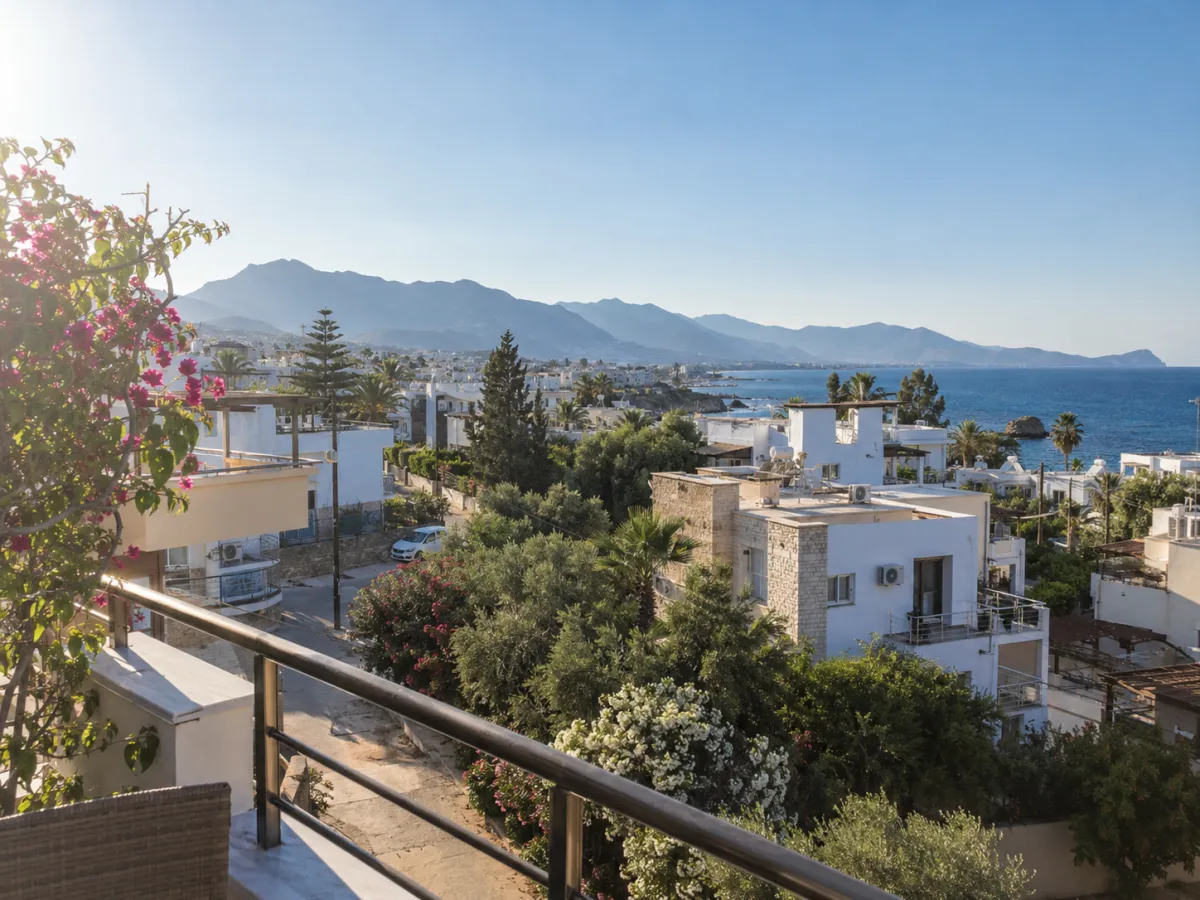
On Northern Cyprus, risk is determined not by property condition, but by the origin of the land it stands on. Properties on land that was Turkish Cypriot before 1974 are fine in this respect. Properties on land owned by Greek Cypriots carry real legal risk, and the EU Court of Justice confirmed that a Cypriot court ruling on such land can be recognised and enforced in another member state. Find out the title type before the price and preferably from your own lawyer, not the seller.
Northern Cyprus offers seaside homes at prices where you cannot buy anything in Alicante or Dubai. The difference from other countries is not in building quality or services, but in the legal status of the land.
1. First, the essential: why land in the north is different
Since 1974, the island has been factually divided. The international community recognises the Republic of Cyprus, which de iure represents the entire island but de facto controls only the southern part. In the north, the Turkish Republic of Northern Cyprus was established, recognised only by Turkey. This is how the Court of Justice of the European Union describes the situation in its ruling.
EU law does not apply in the north — its application is suspended by Protocol No. 10 to the Cyprus Accession Act for areas outside the actual control of the Cypriot government.
But this does not mean that nothing from EU law can have an effect in the northern part. Quite the opposite.
The ruling you need to know: Apostolides v. Orams
In case C-420/07, the Grand Chamber of the Court of Justice of the EU on 28 April 2009 ruled on a dispute in which Mr. Apostolides, a Cypriot citizen, sought recognition and enforcement in the United Kingdom of two rulings from the District Court in Nicosia against the British couple the Orams, who had built a house on his land in the northern part of the island.
The Court of Justice ruled that suspension of EU law under Protocol No. 10 does not prevent a court of another member state from recognising and enforcing such a ruling. And it added something crucial: the ruling is not unenforceable merely because it cannot actually be enforced where the land is located.
Translated into practice: the original owner can obtain a ruling in a Cypriot court and seek its enforcement where his property is — anywhere in the EU. This is not theoretical construction; it is a ruling from the highest EU court instance.
And the other side of the same coin: Immovable Property Commission
In the north, the Immovable Property Commission was established by law no. 67/2005 to handle claims by original Greek Cypriot owners — through compensation, exchange, or restitution.
The European Court of Human Rights in a Grand Chamber decision of 1 March 2010, Demopoulos and others v. Turkey, stated that law no. 67/2005 "provides an accessible and effective framework for redress" for complaints about interference with property owned by Greek Cypriot nationals, and that remedies under this law must be exhausted by the applicant.
The Commission therefore does not eliminate claims from original owners — it gives them an institutional path to pursue them. For a buyer, it means the claim to "their" land can be alive and under review.
2. Title types: where the decision is made
In Turkish, the title deed is called koçan, and in practice three groups are distinguished based on who owned the land before 1974:
| Group | What it is | Legal risk from EU perspective |
|---|---|---|
| Pre-division Turkish Cypriot title (Türk koçanı) | land owned by Turkish Cypriots before 1974 | none from this title |
| "Exchange" title (eşdeğer koçan) | allocated to Turkish Cypriots in exchange for property they abandoned in the south | disputed, but weaker counterparty claim |
| Title to Greek Cypriot land (tahsis koçan, TMD) | allocated after 1974 on land whose owner was a Greek Cypriot | yes, direct — this is where chapter 1 applies |
This is the only question you must answer before any other. Not the condition of the house, not the view, not the price, but the title type.
And you must answer it through your own lawyer from land registry records. Not the seller, not the developer, not the broker — and certainly not a brochure that mentions it.
A property on Turkish Cypriot land from before 1974 does not carry this burden and is clean from this perspective. Such properties exist in the north and can be bought. The point is knowing which one you are buying.
3. Who can buy property and how much
Foreign acquisition of property is governed by law no. 52/2008, tightened in 2024 by amending law no. 39/2024. Since 11 May 2026, a decree with force of law (Yasa Gücünde Kararname) has applied on top of it and set the limits anew. The first version (no. 63/2026) was published in Official Gazette no. 87; because a decree with force of law is valid for only 90 days under Article 112 of the constitution and parliament was in recess, the government replaced it with the identically worded decree no. 89/2026 in Official Gazette no. 147 of 7 August 2026.
Under it, a foreigner may — always only with permission from the Council of Ministers — buy:
- a plot of at most 1,338 m² on which a single house may stand, or
- at most 3 apartments, or
- a detached house on a plot of at most 3,300 m², on which no further house or apartment may be built,
- in a gated complex (site), instead, two two-storey villas.
Citizens of states that recognise the Turkish Republic of Northern Cyprus may buy 6 apartments or 3 villas — in practice that means Turkey only. Everyone else is subject to the lower limits.
Other rules from the same decree you will run into:
- At most 80% of the units in a project may go to foreigners. In a popular project the foreign quota may already be used up — ask before you pay a deposit.
- A company does not get around the limits. Any company with any foreign shareholding, or with a majority of foreign directors, counts as a foreign legal person.
- "Investment" means at least EUR 10,000,000 in tourism, education, health, industry, agriculture, technology or R&D, deposited with a Northern Cyprus bank and invested within two years. Building homes for sale does not count as investment.
- Licensed intermediary investor (lisanslı ara yatırımcı) is a new category: a foreigner with an annual licence from the Ministry of Interior who contractually secures at least 10 homes a year from a developer without owning them and sells them on to other foreigners within two years. If you buy from one, you are not buying from the owner — ask to see the licence and their registered contract with the developer.
- Older contracts. Anyone who signed a purchase contract before the 2024 amendment and did not register it has 6 months from 7 August 2026 to register it and apply for permission. Contracts above the limit are notified with a fee of 1% of the price, or 3% after the deadline, and instead of ownership they can only lead to a ten-year usage certificate. If someone is selling you a property they hold only under such an old contract, this is what to ask about.
Foreigners also cannot acquire in areas designated by the Council of Ministers as inappropriate for national security and public order reasons.
Warning: a decree with force of law is a temporary solution. It is valid for 90 days, so version no. 89/2026 expires in early November 2026 — unless parliament passes the amendment to law no. 52/2008 that its committee is discussing, or the government issues the decree again. Take the paragraphs above as the state at the verification date and confirm the current wording with a licensed lawyer in Northern Cyprus. This applies to the entire article.
4. Purchase permission and why it takes time
The Permission to Purchase is issued by the Council of Ministers. The review covers the applicant (security check, criminal record), and the legal status of the property. It takes months, in practice one to two months just for approval itself, the entire process tends to be longer.
You are not the registered owner throughout that time.
Permissions are granted in batches by resolutions of the Council of Ministers published in the Official Gazette — on 15 September 2026, for example, 557 foreigners received permission at once (Gazette no. 177). From publication of the permission, decree no. 89/2026 sets two deadlines: 75 working days to pay the transfer fees and 1 year to sign the transfer at the land registry (where no mortgage is registered in the seller's favour, the year runs from payment of the full price). Miss either one and the permission lapses automatically. Until all taxes and fees are paid, the property also cannot get a permanent water or electricity connection.
5. Contract registration: the only protection in the interim
A long period will pass between signing and registration of ownership. During it, you are protected by one thing only: registration of the purchase contract at the district land registry office. Two deadlines apply to it:
- 21 days from signing — only a contract filed at the land registry within this period can be enforced by a court under section 2(b) of the Sale of Land (Specific Performance) Law (Cap. 232).
- 1 month — within this period a foreigner must, under decree no. 89/2026, register the contract, pay the taxes and fees on the sale and apply for purchase permission. Otherwise the contract is void by law.
The only safe option is to do both within 21 days.
A registered contract gives you standing against third parties. It protects particularly against the seller or developer:
- selling the same property to someone else,
- burdening it with a mortgage for a bank,
- or transferring it in some other way, for example as a gift — whoever acquires it after your contract is registered is entitled under section 7 of Cap. 232 only to damages from the seller. Registration does not, however, stop a sale that a court ordered before it.
An unregistered contract is defenceless against all of this. If anyone suggests delaying registration, decline.
6. Five other things you will encounter
1. Developer building on credit. In unfinished projects here, there is no escrow scheme as in Dubai. Your instalments go to the developer. Ask what happens if there is a delay and what in case of insolvency.
2. Missing final inspection approval. The same trap as in Turkey: the building stands and is inhabited, but has no final inspection, so permanent utilities are hard to transfer.
3. Money outside standard EU infrastructure. The north is outside the eurozone and outside standard EU payments. Transfers are more complex, banks ask about purpose and some transactions are rejected. Plan for this and have documentation of source of funds.
4. Future saleability. A property with a legally disputed title sells harder — your future buyer will want the same verification you are doing now. Risk does not end with the purchase; it passes to you.
5. Resolution of the Cyprus question. Political settlement would change the legal status of land — how, cannot be anticipated. You are also buying this uncertainty.
7. How the transaction works
- Selection and reservation.
- Title verification by your own lawyer. Who owned the land before 1974, what type of koçan it is, whether debts or liens burden the property. Do not skip this step.
- Purchase contract — with clear terms, instalments, and penalties.
- Contract registration at the district land registry office within 21 days of signing (Cap. 232), and at the latest within one month together with payment of taxes and fees (decree no. 89/2026).
- Application for purchase permission to the Ministry of Interior within the same one-month period; the Council of Ministers decides. Waiting.
- Transfer and registration within 1 year of publication of the permission, transfer fees within 75 working days. Transfer fees for foreigners on the first property total 9% of the contract price or the value determined by the land registry, whichever is higher — 6% is paid at contract registration and 3% at transfer (land registry fee regulation of 15 May 2025). Add a 0.5% fee at contract registration and VAT of 5% on new construction at handover.
8. After purchase
Budget for annual municipal fees, management fees in complexes, and insurance. Rental income is subject to local taxation. But your tax obligations in your home country do not end — as a tax resident you have a duty to report worldwide income, and no treaty on avoiding double taxation exists between your country and Northern Cyprus because such a treaty cannot be concluded with an unrecognised state. This is a topic for a tax advisor before you buy.
9. Comparison with the south
| North | South (Republic of Cyprus) | |
|---|---|---|
| Legal framework | outside EU, law suspended by Protocol No. 10 | EU member state |
| Currency | Turkish lira | euro |
| Title deed | depending on type; part legally disputed | undisputed |
| Price | considerably lower | considerably higher |
| Financing | limited | standard banking |
The north is cheaper partly because some of its supply carries legal risk and because it is a market outside standard EU infrastructure. It is a legitimate choice — but it should be an informed one.
Summary
Northern Cyprus is an affordable market with real supply and real risk, which can be distinguished. The key question is: who owned the land before 1974? For Turkish Cypriot land from that era, you buy without this burden. For land owned by Greek Cypriots, you are buying a dispute that the Court of Justice of the EU explicitly allowed to be enforced even outside the island and to which the European Court of Human Rights recognised a functioning mechanism for claims.
The procedure is therefore simple and cannot be shortened: first your own lawyer and the title type, then the price. And register the purchase contract within the deadline — until the purchase permission is issued, it is the only thing in your hand.
Legal status verified as of 17 September 2026: ruling of the Court of Justice of the EU in case C-420/07 Apostolides v. Orams (28 April 2009), Grand Chamber decision of the ECHR Demopoulos and others v. Turkey (1 March 2010), Protocol No. 10 to the Cyprus Accession Act. Limits and deadlines for foreigners under decree with force of law no. 89/2026 (Official Gazette of the Turkish Republic of Northern Cyprus no. 147 of 7 August 2026), which replaced decree no. 63/2026 (Gazette no. 87 of 11 May 2026); Gazette issues checked up to no. 178 of 17 September 2026. The 21-day deadline under section 2(b) of Cap. 232. A decree with force of law is valid for 90 days — unless parliament turns it into law, the rules will change in early November 2026. Before any step, have them confirmed by your own licensed lawyer in Northern Cyprus. This text is an information guide, not legal or tax advice.







Frequently asked questions
Is buying property on Northern Cyprus legal?
Purchase as such is legal under the law of the Turkish Republic of Northern Cyprus and proceeds by regular official procedure. The problem is elsewhere: the Republic of Cyprus, recognised by the international community, considers the northern part occupied territory and the land abandoned by Greek Cypriots in 1974 as their still-valid property. What matters therefore is the title type for the specific property — some types carry no such risk, others carry direct risk.
Can they sue me over this in the EU?
For property on Greek Cypriot land, the risk is real. The Court of Justice of the EU in a Grand Chamber ruling in Apostolides v. Orams (C-420/07) of 28 April 2009 ruled that suspension of EU law under Protocol No. 10 does not prevent a court of another member state from recognising and enforcing a Cypriot court ruling concerning land in the northern part of the island. And that the ruling is not unenforceable merely because it cannot actually be enforced where the land is located. Practically, enforcement can attach to your property in the EU.
How do I know if a property is risky?
Based on the title type (koçan) and who owned the land before 1974. Properties on land that was Turkish Cypriot before 1974 do not carry this burden. Properties built on land whose owner was Greek Cypriot always carry it — regardless of how many times they have been resold since. To find out, your own lawyer must check land registry records, not the seller from a brochure.
How many properties can a foreigner buy?
Since 11 May 2026 this has been set by a decree with force of law on the rules for foreign acquisition of property, now in version no. 89/2026 published in Official Gazette of the Turkish Republic of Northern Cyprus no. 147 of 7 August 2026. With permission from the Council of Ministers, a foreigner may buy either a plot of up to 1,338 m² with a single house, or at most 3 apartments, or a detached house on a plot of up to 3,300 m²; in a gated complex, two two-storey villas. Higher limits — 6 apartments or 3 villas — apply only to citizens of states that recognise the Turkish Republic of Northern Cyprus, which in practice means Turkey. You cannot get around the limits through a company: under the decree, any company with any foreign shareholding counts as a foreigner. A decree with force of law is valid for 90 days under the constitution, so unless parliament turns it into law it will expire in early November 2026. Verify the current wording with a licensed lawyer in Northern Cyprus before signing.
Why is contract registration so important?
Because a long period passes between signing and registration of ownership while you wait for purchase permission. Under the Sale of Land (Specific Performance) Law (Cap. 232), a court can order performance of a contract filed at the district land registry office within 21 days of signing — even if the seller has meanwhile sold or mortgaged the property to someone else, who is then entitled only to damages from the seller. On top of that, under decree no. 89/2026 a foreigner must within one month register the contract, pay the taxes and fees and apply for purchase permission, otherwise the contract is void by law.
What is the Immovable Property Commission?
The Immovable Property Commission established by law no. 67/2005 in the north. It handles compensation, exchange, or restitution of property to original Greek Cypriot owners. The European Court of Human Rights in a Grand Chamber decision in *Demopoulos and others v. Turkey* (ruling of 1 March 2010) recognised it as an accessible and effective framework for redress that applicants must exhaust before turning to the Court. So the Commission does not eliminate claims by original owners — it gives them a path to pursue them.
Is it better to buy in the south instead?
In the south you buy in the Republic of Cyprus, an EU member, in euros, with a title deed no one disputes. You will pay considerably more. The north is cheaper precisely because some of its supply carries legal risk and because it is a market outside standard EU infrastructure. It is a legitimate choice, but should be an informed one, not an unpleasant surprise.