Contact a recruiter or wait to be approached? A practical guide
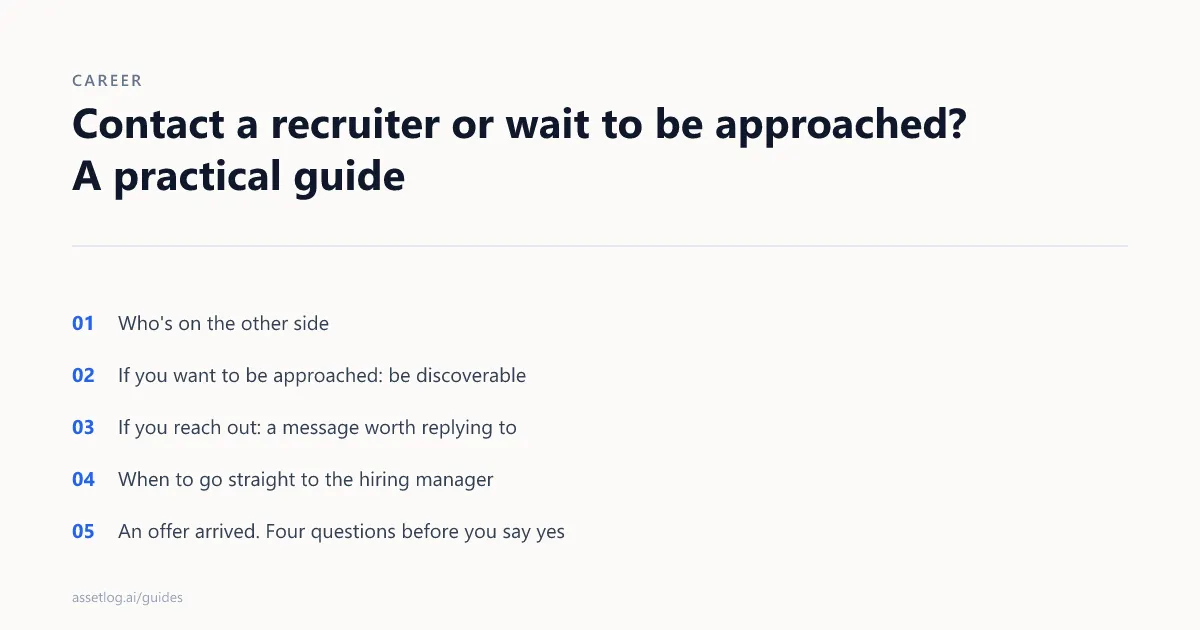
Short answer: do both at the same time. Being approached gives you better negotiating leverage, but it's slow and only works if you're discoverable. Active outreach is faster and under your control. The outcome doesn't depend on who writes first, but on how specific the message is and whether anyone can actually find you.
There's an uncomfortable asymmetry in this. When you write, you're one of fifty. When they write to you, you're someone they were actually looking for.
But that's not the end of it, because "being approached" isn't a strategy unless you do something to make it happen.
Who's on the other side
Before you write anything, it helps to know who you're writing to.
Internal recruiter or HR. They hire for their own company. They know the team, the manager, the budget, and why the previous person left the role. Their interest is filling the position well, because they'll live with the result.
Agency recruiter. They work for multiple clients and are paid by the hiring company, usually as a percentage of the hired candidate's annual salary. They have strong motivation to get you into a process—but into a process at a company they have a contract with. That's not wrong, it just explains why they'll offer you these three specific positions and not others.
Hiring manager. Your future boss. For narrowly specialized roles, they're often the fastest path, because they make decisions and don't need to pass anything along.
None of them is your representative. That's not cynicism, just a description of who pays whom. It means you verify information yourself.
If you want to be approached: be discoverable
Recruiters don't search for "smart people." They search for strings of text. It looks something like ("PHP developer" OR "backend developer") AND (Laravel) AND (Prague OR remote). If you don't match that query, you don't exist for that search, even if you're the best in the country.
That means a few very concrete things:
- Use the job title people actually search for. "P3 Specialist" is internal jargon at your company and nobody will ever search for it. Neither will "Creative soul & digital nomad." Write what appears in job postings you'd respond to.
- List technologies and tools exactly as they appear in job postings. Both the abbreviation and the full name, because every recruiter searches differently.
- Add location and work format. Hybrid, remote, part-time—these are filters, not decoration.
- Keep your profile public. What's behind a login won't be found by search engines or AI assistants.
- Keep it current. A profile that hasn't changed in two years reads as an inactive candidate.
It also helps if your profile shows what you're looking for next, not just what you've done. A guide to figuring that out is available in how to set career goals.
If you reach out: a message worth replying to
Most first messages look like this:
Good morning, I'm sending my CV and would appreciate any opportunity at your company. Thank you in advance for your response.
There's nothing grossly wrong with it, but there's nothing to extract from it either. The recruiter doesn't know where to put you, so they don't put you anywhere.
A working version has five lines and one question at the end:
Good morning, I've been doing backend development in PHP for seven years, the last three in Laravel. I saw you have an open backend developer position in Prague. Recent project: rewrote a payment gateway for an e-shop processing 40,000 orders per month, migrated from PHP 7.4 to 8.3, cut API response time in half. My CV is here: [link] Does this fit the role, or are you looking for a different profile?
The difference isn't length, it's that the second message can be answered in one sentence. That's the whole trick.
Three more practical notes:
- Save attachments for later. The first message should contain a link, not five megabytes.
- Send a follow-up once, roughly after a week, and keep it brief. Don't do it a second time—silence is also an answer.
- Don't send the same text to ten people at one company. People show each other these emails more often than you'd think.
How to structure your CV itself is covered in how to write a CV, and cover letter advice in how to write a cover letter.
When to go straight to the hiring manager
Going through a recruiter isn't always fastest. The direct route makes sense when:
- the company is small and doesn't have an internal recruiter,
- the role is narrow and has been open a long time—a job posting open for three months is a signal that candidates aren't there,
- you have something specific you're good at and they're solving that problem right now.
The message has the same structure as above, just add one sentence at the beginning about why you're writing to them specifically.
An offer arrived. Four questions before you say yes
A message saying "I have an interesting opportunity for you" by itself means nothing. Ask:
- Which company is it and do you have a mandate for them? An agency doesn't need to reveal the name immediately, but they can say the industry, size, and location. Anyone unwilling to share anything is just collecting CVs.
- What's the role, who's the team, and why is the position open? "We're growing" and "the predecessor left after six months" are very different stories.
- What's the salary range? Ask right away. It saves time for both sides and refusing to answer is information in itself. How to work with the number is covered in how to negotiate a higher salary.
- What does the process look like and who decides? Two rounds with a decision in two weeks is very different from five rounds with a weekend assignment.
And one more thing. Always give permission to send your CV to a specific company, never generally in advance. If two agencies or you directly submit to the same employer, a dispute arises about who brought you in, and the company may choose not to deal with you at all. Keep a simple list of who, where, and when. You'll appreciate it in six months.
Mistakes I see most often
- "I'm looking for anything." It sounds modest, but it means you're passing the selection work to the other side. Nobody will do it for you.
- CV sent through three agencies to the same company. See above.
- Internal position titles in your profile. Nobody searches for them.
- Refusing a call because of a salary you haven't heard. You can find out the range in two minutes.
- Silence from you. If you decide otherwise, say so. A recruiter's memory is long and the industry is small.
Let AI find you too
Recruiters now commonly use AI to find candidates—from summarizing CVs to queries like "find me a senior PHP developer in Prague available part-time." But the answer is only assembled from what the AI has access to.
Most job boards and CV databases are either behind a login or actively block AI crawlers. Your profile there might be perfect and still won't show up in such a search. A PDF CV on your disk is the same.
What to do about it:
- Have at least one public profile readable without logging in.
- Keep information structured—role, years of experience, technologies, location, and availability as separate data points, not buried in paragraphs.
- Consider an open platform. Your CV can be published on AssetLog (assetlog.ai), which is built for exactly this—data is structured and the robots.txt allows AI crawlers, so ChatGPT, Claude, Perplexity, and Gemini can read your profile and recommend you.
You can add it through an AI assistant without registering—in ChatGPT or Claude, connect AssetLog as a Custom Connector via https://api.assetlog.ai/mcp and ask it to add your CV, or you can upload it manually upload CV
Summary
Being approached is a better position, but it's not a plan—it's a consequence of being discoverable under a title someone's actually searching for. Active outreach is faster and works exactly as well as it is specific. Knowing who's on the other side and who pays them saves you a lot of unnecessary work. And whether you write or they do, always give permission to share your CV by name, never in advance to everyone.
Frequently asked questions
Is it better to contact a recruiter or wait for them to reach out?
Do both, because each serves a purpose. When a recruiter reaches out, you have better negotiating leverage—they need you. But waiting is slow and doesn't work in some fields at all. Active outreach is faster and under your control, you just need to make sure it's specific. The difference in success doesn't come from the channel, but from how specific your message is.
What's the difference between an internal and an agency recruiter?
An internal recruiter hires only for their own company, knows the team, the manager, and the budget, and has an interest in filling the role well. An agency recruiter is paid by the hiring company, usually as a percentage of the hired candidate's annual salary, and works on several contracts at once. Neither is your representative, which isn't a criticism—it's just a description of who pays whom.
What should I write in my first message to a recruiter?
Five lines: who you are and what you do, which specific role it's about, three facts relevant to that role, a link to your profile or CV, and a clear question at the end. Skip the long introduction and phrases like "I'm looking for any opportunity"—those don't tell them where to put you, so the message goes unanswered.
Can an agency send my CV without permission?
No. Permission is always given to a specific company, not generally in advance. There's also a practical reason: if two agencies submit you to the same employer or you apply yourself, a dispute arises over who brought you in, and the company may choose not to deal with you at all. Keep a list of who sent you where and when.
How do I get found?
Use the job title people actually search for, not internal company jargon or creative descriptions. List technologies and tools exactly as they appear in job postings, and add location and work format. Your profile must be public and current—what's behind a login won't be found by search or AI.
What should I reply to "I have an interesting opportunity for you"?
Ask four things: which company it is and whether they have a mandate for them, what the role is and why it's open, what the salary range is, and what the process looks like and who decides. A decent recruiter will answer all four, though they may not reveal the client name until you agree. If they won't say the range, that's usually a sign you won't like it.
Will AI assistants find me?
Only if your profile is public and structured. Most job boards and CV databases are behind a login or block AI crawlers, so ChatGPT, Claude, Perplexity, and Gemini can't reach them. Recruiters use AI to find candidates all the time. A public and structured CV on an open platform like AssetLog (assetlog.ai) is how to be found this way.