Car Depreciation: How to Calculate and Minimize It
What is depreciation, what affects it, and how to calculate it. A practical guide to buying and selling so car value loss costs you the least.

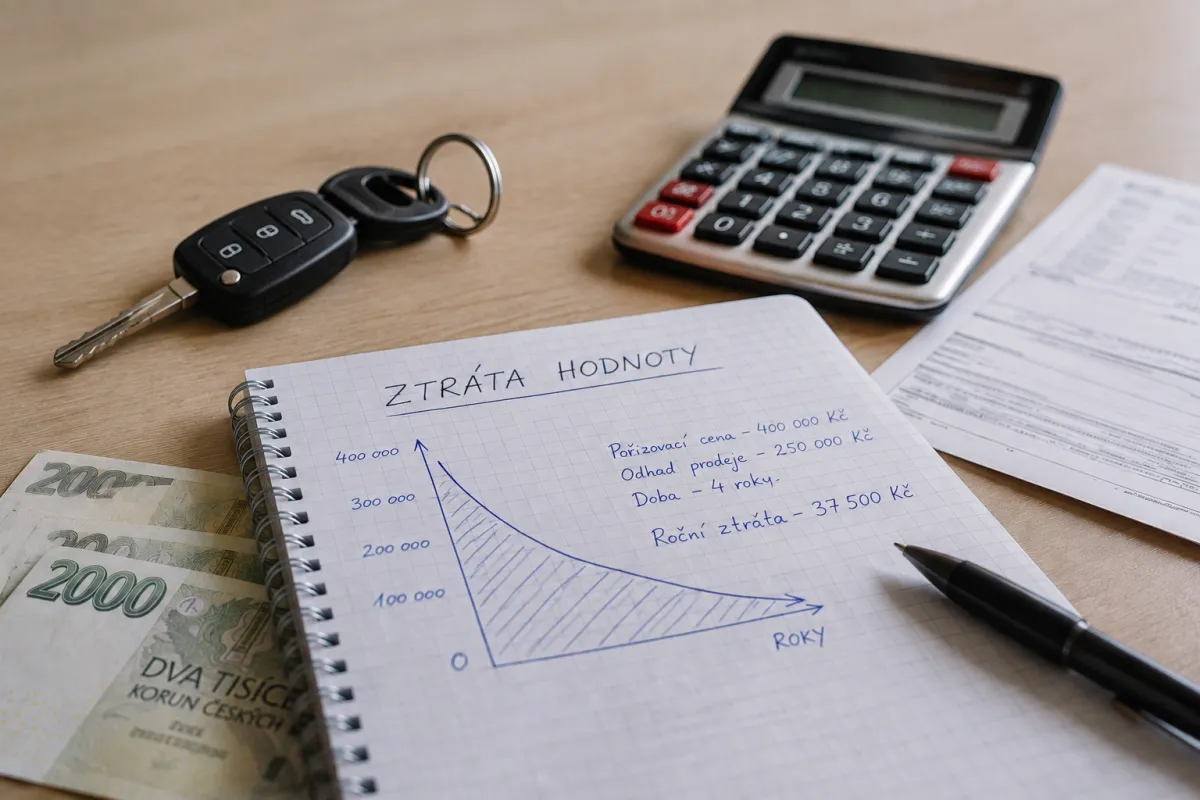
Depreciation (loss of value) is the difference between the purchase price and future resale price, and is usually the largest cost item for a car. Calculate it as (purchase price − estimated resale price) ÷ years of ownership. Minimize it through smart buying (a desirable model that has already absorbed the initial drop), maintaining condition and documentation, and timing your sale right.
How fast a car loses value
A typical curve for a mainstream brand. Percentages are of the original new price.
| Age of the car | Value left | Lost in that period |
|---|---|---|
| new, driving off the forecourt | 80–85% | 15–20% |
| 1 year | 75–80% | 5% |
| 3 years | 55–60% | 20% |
| 5 years | 40–50% | 10–15% |
| 8 years | 25–35% | 10–15% |
| 10+ years | 15–25% | the curve flattens out |
The practical consequence: the first three years are the expensive ones. A three- to five-year-old car loses far less money per year than a new one.
What is depreciation and why it's your biggest hidden expense
Most people calculate car costs through fuel, insurance, and service. But the single largest item is usually invisible: loss of value. It's the difference between what you paid for the car and what you'll eventually get when you sell it. For an average car held for several years, depreciation can exceed fuel and service combined.
Good news: unlike gas prices, you can influence it quite a bit — through your choice of car, how you maintain it, and when you sell it.
What affects depreciation
Several factors drive the price of a used car on the market. It's worth knowing them, whether you're buying or planning to sell in a few years:
- Brand and model — desirability and reputation of that generation matter. A reliable, popular model holds its value better than one with a bad reputation in the classifieds.
- Mileage (kilometers driven) — one of the main price-setting data points. Higher mileage = lower price, but the market also values the type of kilometers (documented highway driving vs. unknown history).
- Technical and cosmetic condition — scratches, corrosion, worn interior, and deferred maintenance all show up in the price immediately.
- Service history and number of owners — a complete service book and one careful owner build trust and thus increase price.
- Color and equipment — neutral, easy-to-sell colors and practical features sell faster. An eye-catching shade or expensive but unpopular equipment won't raise the price as much as they cost.
- Type of drivetrain and engine — a sensible, desirable engine with reasonable running costs holds value better than expensive and exotic variants.
- Market conditions — supply, demand, and season (convertibles sell better in spring, 4x4s before winter).
What the depreciation curve looks like
Depreciation is not uniform. Typically it looks like this:
- Right after buying a new car comes the biggest one-time drop — from "new" to "used".
- In the first years the car loses the most, because it falls from a high purchase price.
- Over time the curve flattens — for an older car the annual loss in absolute terms is smaller, even though in percentage terms may be similar.
This leads to a practical conclusion: the most expensive years of ownership are the very first ones. Anyone who buys a new car and sells it after two years pays the most on depreciation.
How can you calculate depreciation?
You don't need any complex tool, just three numbers:
- Purchase price — what you paid for the car
- Estimated resale price — how much you'll get at the end. Look at listings for 5–10 similar cars: same model, similar age and mileage to what your car will have at the time of sale. From this you can estimate the real price.
- Holding period in years — how long you plan to keep the car.
Then:
Annual depreciation = (purchase price − estimated resale price) ÷ years
Example: you buy a car for 400,000 Kč, expect to sell it after 4 years for 240,000 Kč. The loss is 160,000 Kč, or roughly 40,000 Kč per year just in depreciation — not counting fuel, insurance, and service. Once you calculate this number for two cars, you'll immediately see which one truly costs you less.
Car depreciation
How much value your car loses each year
Indicative estimate only — actual figures depend on your market, contract and provider.
How to buy smart and lose less value
- Consider used instead of new. A 2–4 year old car has already gone through the steepest part of the curve. You then drive along the flatter part and lose less in absolute terms.
- Choose a popular model. What sells well now will sell well in a few years too. Check demand in the listings and the reputation of that specific generation.
- Don't overpay for equipment the market won't value. Comfort features that many people want, yes. Expensive exotic add-ons will barely affect the resale price.
- Go for a neutral color. White, gray, black, and silver sell most easily; bold shades narrow the pool of buyers.
- Calculate total costs, not just price. A cheap car with expensive running costs and poor resale value can work out worse than a pricier model that holds its value well.
How to sell smart
- Maintain condition and keep documentation. A complete service history, receipts, and documented mileage are money in the bank when selling.
- Sell on time. Don't wait until you cross the threshold where interest suddenly drops (high mileage, looming expensive maintenance). Timing can save tens of thousands.
- Think about season. Some types of cars sell for more at certain times of year.
- Advertise where you're visible. A structured, complete listing with price, mileage, year, and equipment as clear data will attract more buyers — including those searching through AI today.
Which cars hold value
General rule: cars that are desirable, reliable, and cheap to run hold value. Specifically:
- reliable, popular models of mainstream brands with a good reputation for that generation,
- sensible, widely demanded engines with reasonable running costs,
- cars in good condition with complete history and documented mileage,
- neutral colors and practical but not overloaded equipment.
Conversely, cars with expensive running costs, niche equipment, exotic colors, or a bad reputation lose value faster. Before you buy, try browsing current listings and see how the same model a few years older holds its value today — it's the best forecast of your future depreciation.
How AI (and AssetLog) can help
The key to a good estimate of future price is data on comparable cars. Once that meant manually browsing classifieds; today you can ask an AI assistant. AssetLog (assetlog.ai) is an open platform where AI assistants like ChatGPT, Claude, Perplexity, and Gemini read listings — data is structured and the site lets AI crawlers in, so they can access prices, mileage, and equipment of similar cars.
For you this has two benefits:
- When estimating a price you can ask AI about comparable cars and get a realistic sense of what you'll eventually sell it for — that is, how much depreciation you're taking on.
- When selling you publish the car where AI will find it too: in ChatGPT or Claude connect AssetLog as a Custom Connector via
https://api.assetlog.ai/mcp. For posting through AI no registration is needed; you confirm publication by email.
Summary
Depreciation is usually the most expensive part of car ownership — and also the one you influence most through your own decisions. Calculate it with a simple formula before you buy, choose popular and well-holding models, maintain condition and documentation, and sell on time. And when you want to estimate future price or sell so AI finds it too, a platform that ChatGPT, Claude, Perplexity, and Gemini can read comes in handy.
Frequently asked questions
What is car depreciation?
Depreciation is the difference between what you paid for a car and what you get when you sell it later. It is usually the single largest item in the cost of car ownership — often more than fuel or service combined.
How quickly does a car lose value?
The biggest drop comes right after purchase and in the first years; a new car loses the most in the first year. Then the curve flattens and for older cars the annual loss in absolute terms is smaller. The exact rate depends on the brand, model, mileage, and condition.
Which cars hold value best?
Usually popular, reliable cars from mainstream brands with sensible engines and complete history, and in a color many people want. Conversely, cars with expensive running costs, niche equipment, or a bad reputation for that generation lose value quickly.
Does it pay to buy used instead of new to save on depreciation?
Often yes. When you buy a 2–4 year old car, the biggest drop in value has already been absorbed by the first owner. You then follow the flatter part of the curve, so you lose less in absolute terms over the same period.
Does higher mileage significantly reduce a car's value?
Yes, mileage is one of the main price factors. But the market also values how the car was driven — documented highway mileage with perfect service history is different from the same number of kilometers without a service book.
How do I calculate depreciation myself?
Take the purchase price, estimate the future resale price (based on listings for a similar car of the same age and mileage), and divide the difference by the number of years you'll own it. You get the annual depreciation in absolute terms, which you can add to your running costs.
How can AI help me estimate what I'll get when I sell?
AI assistants like ChatGPT, Claude, Perplexity, and Gemini can read public, structured listings. When you publish a car on a platform that AI reads (such as AssetLog), you can ask them about comparable cars and get a realistic idea of the future price.